
Can AI Agents Work Together as a Team? Multi-Agent Systems Explained (2026)
Yes, AI agents can work together as a team. In a multi-agent system, several specialised agents share one goal: one researches, another drafts, a third checks the work, and a supervisor pulls it all together. The result is often faster and more reliable than a single agent trying to do everything alone — as long as the job is genuinely worth splitting up.
If you have followed this site’s AI Agents series, you already know what a single agent is: software that takes a goal, plans steps, uses tools and acts on your behalf. A team of agents takes that idea one step further: instead of one long instruction list stuffed into a single agent, each agent gets a short, clear brief. That is the whole secret — and it is why whether AI agents can work together matters so much for small businesses in 2026.
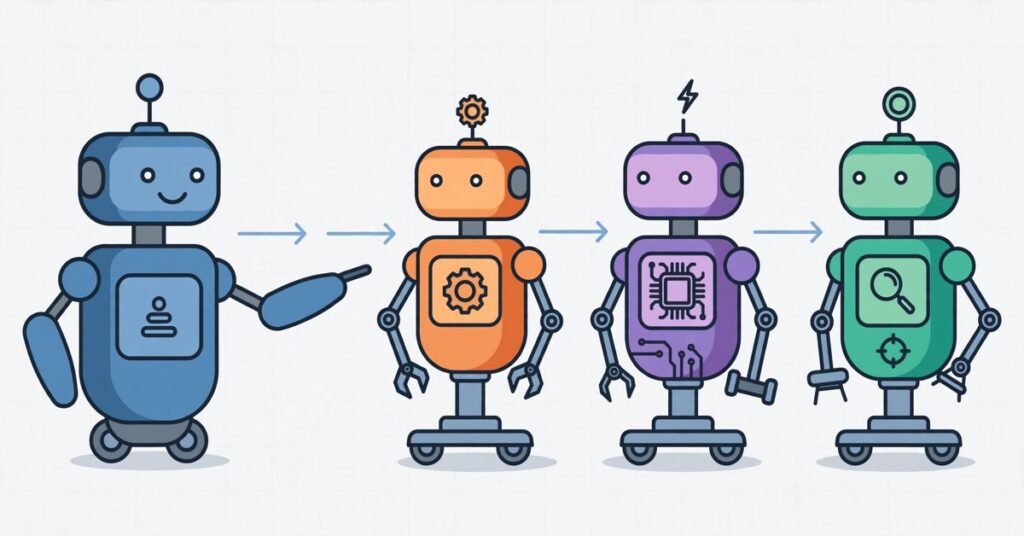
What Is a Multi-Agent System?
A multi-agent system is a setup where two or more AI agents cooperate inside a shared environment to complete a task. Each agent has its own role, tools, instructions and permissions, and the agents pass work to each other through messages or a shared workspace. One agent might search the web, another might write, and a third might review the draft against your rules before anything is sent.
Think of it like a small office team: you would not ask one employee to be researcher, writer, proofreader and bookkeeper at once. Splitting a complex job into specialist roles keeps each agent’s instructions short, which keeps its output reliable.
How AI Agents Work Together: 4 Coordination Patterns
Agents need a way to decide who does what next. Nearly every business system uses one of four patterns, often combined:
1. The relay race (sequential pipeline)
Each agent hands finished work to the next, like runners passing a baton. Lead capture: agent one collects the enquiry, agent two enriches it, agent three qualifies it, agent four books the call. The simplest pattern — and the best starting point.
2. Manager and workers (hierarchical)
One supervisor breaks a request into subtasks, assigns each to a specialist, and assembles the result. In support, the manager routes billing questions to the billing agent and technical questions to the technical agent, then combines both answers.
3. Reviewer and creator (feedback loop)
One agent produces, a second critiques, back and forth until a quality bar is met. A content team might pair a writer agent with an editor agent checking facts, tone and pricing rules before publishing. This catches mistakes a single agent would repeat when checking its own work.
4. Parallel specialists (fan-out)
Several agents tackle independent subtasks at once, then a manager merges the results. A research task might send one agent after market data, another after documentation, a third after regulation, a fourth after competitor pricing.
A Real Small-Business Example: The Lead Follow-Up Team
Here is how a four-agent team could handle every new enquiry for a small service business:
- The capture agent watches your website form and inbox, and logs each enquiry in your CRM within seconds.
- The research agent looks up the enquirer’s company and adds a short note: what they sell and what problem they probably have.
- The drafting agent writes a personalised first reply from that research and queues it for your approval.
- The booking agent sends the approved reply, offers calendar slots, and follows up if nobody answers within two days.
Notice the human approval gate in step three. That is deliberate: a team of agents can prepare and propose, but messages carrying your name should pass through you until you trust the system — the same human-in-the-loop principle from our guide to whether AI agents are fully autonomous.
Why a Team Beats One Agent — and When It Does Not
A team wins in four ways: specialisation (narrow briefs beat one giant prompt), parallelism (independent subtasks run at once), independent checking (a separate reviewer catches errors the creator missed), and context isolation (each agent sees only what it needs, so the manager gets a short summary, not every document and tool trace).
But a team is not always the answer. Every extra agent adds model calls, messages and cost — Anthropic’s multi-agent research system used far more tokens than ordinary chat, and multi-agent setups were substantially more expensive than single-agent ones in its internal measurements. A team also multiplies failure modes: agents pass errors to each other, duplicate effort, or misunderstand a handoff.
So here is the honest test: does the work have genuinely different modes — research versus writing versus approval versus data entry — needing different tools and error tolerances? If yes, a team will probably beat one agent. If the work is one mode repeated, a single agent with good tools is cheaper and easier to debug. And if you have never shipped a single agent yet, build one first — the gaps it reveals will tell you exactly where a second agent belongs.
How to Start: Tools and Your First Two-Agent Team
You do not need to write code to experiment. Frameworks like Microsoft’s AutoGen, CrewAI and LangGraph support multi-agent setups, and no-code platforms such as n8n and Make let you wire agents together visually. No-code multi-agent tools commonly start around $19–$49 per month; the bigger investment is your time designing and testing the workflow.
The sensible first team is the smallest one that solves a real pain: two agents, not five. Start with the relay race for one process you already do by hand — lead follow-up is the classic choice because it sits closest to revenue. Give each agent a one-paragraph brief, a short tool list, and a clear rule for when to stop and ask a human. Test it on ten real enquiries before it touches a customer unsupervised, and log every handoff so you can see exactly where it breaks.
So, can AI agents work together as a team? Absolutely — and for the right job, a small team of specialists will outperform one overloaded agent. Start with one workflow, two agents and a human approval gate, and let the results tell you where the team should grow next.
AI agents can work together without constant human supervision, but a human should still approve anything financial, irreversible or sent under your name. Most reliable multi-agent systems use approval gates on the steps that matter and let agents run freely only on reversible, low-risk steps.
A small business team should start with two or three AI agents covering one workflow, such as lead follow-up. Add agents only when a clear gap appears — for example, a reviewer agent when output quality slips, or a research agent when replies feel generic.
Yes, a team of AI agents costs more than one agent because every agent adds model calls, messages and context. Anthropic found multi-agent systems substantially more expensive than single-agent setups, so teams are worth building only for complex, repeatable workflows where the quality gain pays for the extra cost.
No-code platforms such as n8n, Make and Zapier let AI agents work together without coding by connecting agents in visual workflows. Code-friendly frameworks like CrewAI, AutoGen and LangGraph offer more control for teams that outgrow no-code tools.
AI agents can work together across different companies through shared protocols such as Google’s A2A (Agent2Agent), which lets agents from different organisations exchange tasks without sharing raw internal data. This kind of cross-company agent teamwork is still early in 2026 but is the direction the industry is heading.