Can I Learn AI Without a Math Background? The Honest 2026 Answer
Yes — you can learn AI without a math background. If your goal is to use AI tools at work or in your own business, you need almost no maths at all. If you want to build machine learning models from scratch, you’ll need some statistics eventually — but you can start now and pick it up as you go, one idea at a time.
That distinction is the whole answer, and most guides skip it. They either tell you “don’t worry, maths doesn’t matter” (not true for builders) or “you must master calculus first” (not true for almost anyone starting in 2026). The honest version: the maths you need depends entirely on which lane you’re in. This guide shows you how to learn AI without math background skills holding you back, which lane fits your goal, and exactly what to learn first.
The Honest Short Answer: It Depends on Your Lane
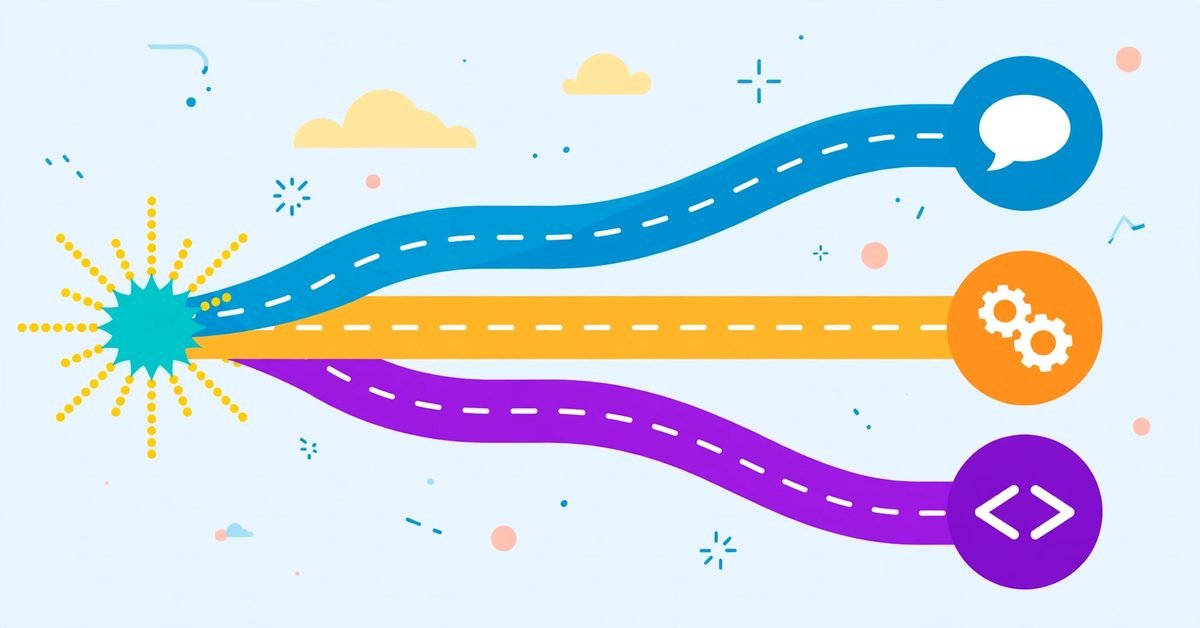
There are really three ways people “learn AI” in 2026, and they need wildly different amounts of maths:
| Lane | What you do | Maths needed |
|---|---|---|
| 1. AI user | Use ChatGPT, Claude, Gemini, image and video tools for real work | Almost none |
| 2. AI operator | Build workflows, prompts, automations and no-code agents | Basic number sense |
| 3. AI builder | Train and tune machine learning models with Python | Statistics, then linear algebra later |
Most beginners who ask this question are aiming for lane 1 or 2 — and for those, a weak school maths record is genuinely not a barrier. You don’t need a degree, you don’t need to love algebra, and you certainly don’t need to pass a calculus exam before you’re allowed to start. What you do need is curiosity, patience with mistakes, and a habit of building small things instead of just watching tutorials.
Using AI vs Building AI: The Split That Changes Everything
Think of it like driving versus engineering a car. You can be an excellent driver without knowing how the engine works — and nobody sensible tells a new driver to study thermodynamics first. Using AI tools is driving. Building models is engineering. Anyone setting out to learn AI without math background knowledge should decide their lane first, because it determines everything they study next.
As an AI user, your real skills are prompting, judging output, and knowing when the tool is wrong. You give clear instructions, add context and examples, check the result, and iterate. None of that is maths. The people getting the most value from AI at work in 2026 aren’t mathematicians — they’re marketers writing better briefs, shop owners answering customers faster, and freelancers drafting proposals in half the time.
As an AI operator, you connect tools together: a form that feeds an AI summary into a spreadsheet, or a chatbot that answers common questions on your website. No-code platforms such as Zapier, Make and n8n, plus tools like Google’s Teachable Machine, handle the maths underneath. Your job is logic and workflow design: if this happens, then do that. That’s reasoning, not equations.
As an AI builder, the maths finally shows up — but later than you think. Modern libraries do the heavy lifting: scikit-learn gives you ready-made models, and TensorFlow’s Keras API lets you build a neural network in a few lines of code without deriving anything by hand. You learn the maths because a project needs it, which is far more motivating than studying it in the abstract.
The Only Maths You Actually Need (and When)
If you do go further, here’s the honest, minimal list — in the order you’ll actually need it:
- Basic statistics (start here): averages, medians, spread, correlation, and what a probability means. This is the maths behind “is this model actually good?” and it covers most beginner projects.
- Reading graphs: can you look at a chart and tell what it says? Can you spot when an average is being dragged around by a few strange values? That number sense matters more than algebra.
- Linear algebra and calculus (much later): vectors, matrices and gradients power deep learning — but you only need them if you move into advanced model building or research. Postpone them until a real project demands them.
Notice what’s missing: you don’t need to be fast at mental arithmetic or to remember school trigonometry. Plenty of working AI practitioners learned statistics through their first projects, not before them. The YouTube channels 3Blue1Brown and StatQuest explain these ideas visually, and they’re the go-to recommendation precisely because they make the maths feel intuitive instead of academic.
Your 3-Lane Plan to Learn AI Without a Math Background
Pick your lane, then follow it for a few weeks before worrying about the next one.
Lane 1 — AI user (weeks 1–2): get fluent with the tools
Choose one general-purpose assistant — ChatGPT, Claude or Gemini — and use it every day for real tasks: drafting emails, summarising documents, brainstorming, learning a topic. The single most valuable early skill is prompting: giving clear instructions, context and examples. Try the same request three different ways and notice how the output changes. That habit alone puts you ahead of most users.
Lane 2 — AI operator (weeks 3–6): build something useful
Pick one repetitive task from your own work and automate it. A no-code workflow that sorts incoming emails, a Teachable Machine model that recognises your products, or a simple chatbot for your website’s FAQs. Free courses help here: Google AI Essentials is built for non-technical professionals and assumes no maths or coding, the University of Helsinki’s Elements of AI covers logic and ethics with no equations, and Andrew Ng’s “AI for Everyone” on Coursera is the classic conceptual overview for managers and founders.
Lane 3 — AI builder (months 2–6, only if you want it): Python, then models
If you catch the bug, learn Python basics — variables, functions, lists, loops — then data handling with pandas, then your first models with scikit-learn: linear regression, decision trees, random forests. Learn each statistics idea the moment your project needs it. A realistic timeline for a complete beginner reaching a first working model is three to six months of steady practice, not years of study first.
What to Skip (for Now)
Beginners waste the most time on the wrong things. You can safely postpone advanced linear algebra, calculus, reading research papers, and building neural networks from scratch. You can also skip buying five courses at once — finish one free course, build one small project, and only then decide what to learn next. The people who stall are usually the ones still “preparing” six months later. The people who progress are the ones with a slightly embarrassing first project already built.
One more honest warning: the maths question sometimes hides a different fear — “am I too late, or not smart enough?” The field is full of career-changers, including people who came from philosophy, economics and the arts. Fast.ai co-founder Jeremy Howard famously pivoted from philosophy and economics into AI. What separated them wasn’t a maths degree; it was that they started building while everyone else was still deciding whether they were qualified.
Conclusion
So, can you learn AI without math background skills holding you back? Yes — start as a user today, grow into an operator over the next month, and only touch the heavier maths if and when you choose the builder lane. The barrier was never really the maths. It was the belief that you had to clear it before starting. You don’t. Pick one tool, use it on a real task today, and let the maths catch up to your ambition — not the other way round.
Yes, you can learn AI without a math background and still get hired, especially for AI user and operator roles such as prompt engineering, AI-assisted marketing, workflow automation and customer-support AI. Employers in 2026 hire for demonstrable projects and tool fluency, not maths degrees, though research and advanced ML engineering roles do require stronger maths.
For using AI tools, you need almost no math beyond everyday number sense. For building machine learning models, you need basic statistics — averages, spread, correlation and probability — learned gradually as projects require it. Calculus and linear algebra only become necessary for advanced deep learning work, not for starting.
Google AI Essentials is the best free starting point for non-technical learners, because it teaches practical AI use, prompting and responsible use with no maths or coding required. Elements of AI from the University of Helsinki and Andrew Ng’s AI for Everyone on Coursera are strong free follow-ups that stay conceptual rather than mathematical.
No, you do not need coding to start learning AI. No-code tools like Google Teachable Machine, Zapier and Make let you build working AI projects without writing code. Coding in Python becomes useful later if you move into the builder lane, but it is not a day-one requirement.
Yes, age is not a barrier to learning AI without a math background. Adult learners often progress faster because they bring real work problems to solve and existing professional judgement. Start with one AI tool used daily on real tasks, then add one small project — steady practice matters far more than age or school maths grades.