
How Long Does It Take to Learn AI From Scratch? (2026 Guide)
How long to learn AI depends on what you mean by “learn AI”: using AI tools well takes a few weeks, building your first AI app takes about 3 to 6 months, and reaching job-ready engineering skills takes 6 to 18 months of steady part-time study. The honest answer is that there is no single timeline — your starting point, your weekly hours, and your goal decide it.
That range frustrates people who want one number, but it is genuinely good news. Most beginners overestimate how long the first useful step takes and underestimate how long real job-ready skill takes. If you only want to use AI at work, you can be productive within a month. If you want an AI job, plan for the better part of a year — and that is still fast for a career change.
How Long to Learn AI: The Short Answer by Goal
The World Economic Forum puts a useful number on the journey: about 30 hours of learning to reach beginner-level AI skills, and about 137 hours to reach advanced proficiency. That is the total study time, not calendar time — 30 hours is three weeks at 10 hours a week, or three months at a couple of hours a week.
Here is how that breaks down by goal:
| Your goal | Realistic timeline | Weekly effort |
|---|---|---|
| Use AI tools well at work | 2–4 weeks | 3–5 hours |
| Build simple AI apps and automations | 3–6 months | 5–10 hours |
| Job-ready AI or ML engineering | 6–12 months | 8–15 hours |
| Job-ready from zero (no coding, no maths) | 12–18 months | 10–20 hours |
| Specialist (deep learning, NLP, MLOps) | 18+ months, then ongoing | 10+ hours |
Notice the pattern: the timeline roughly doubles every time you move one lane deeper. Picking your lane first is the single most useful decision you will make, because it stops you studying the wrong things for months.

The Three Lanes: User, Builder, Engineer
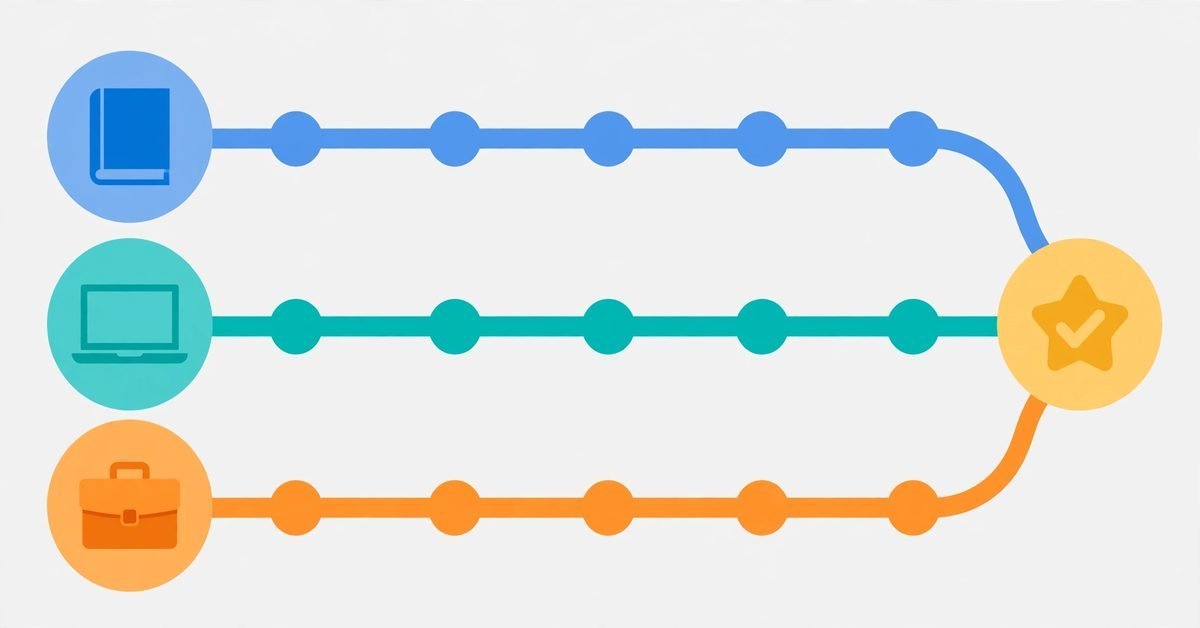
Almost every “how long to learn AI” answer confuses three different journeys. Split them apart and the timeline becomes obvious.
Lane 1: The AI user (2–4 weeks)
You want to use tools like ChatGPT, Gemini, or Claude well at work — writing, summarising, analysing spreadsheets, drafting emails, planning. No coding needed. Learn how the tools actually work, practise on real tasks for 20–30 minutes a day, and within a month you will be noticeably faster than colleagues who are not using them. This is the lane most people should start in, even if they later go deeper.
Lane 2: The AI builder (3–6 months)
You want to build things: a chatbot for your business, an automation that sorts your inbox, an agent that follows up leads. You will need basic Python and an understanding of how to call a model through an API, plus tools like n8n or Zapier for no-code parts. At 5–10 hours a week, most learners ship their first real project in about three months.
Lane 3: The AI engineer (6–18 months)
You want an AI or machine-learning job. That means Python, the maths that matters (statistics, a little linear algebra), classical machine learning, deep learning, and the 2026 essentials — transformers, retrieval (RAG), and agent frameworks. With a programming background, 6–9 months of part-time study is realistic; from complete zero, 12–18 months is the honest range. Bootcamps promising job-ready AI engineering in 12 weeks are selling toy projects, not production skill.
What Slows Most Beginners Down
Time is rarely the real problem. These four traps cost learners more months than any single topic:
- Studying maths first. Beginners who open a linear algebra textbook in week one usually quit by week three. Learn just enough maths when you hit a concept that needs it — the builder lane needs almost none at the start.
- Tutorial hopping. Watching ten “learn AI” videos feels like progress and teaches almost nothing. One structured path, finished, beats five half-finished courses.
- No real project. Learning sticks when it solves your problem. Automate one annoying task from your actual job and you will learn more in a month than in three months of lectures.
- Chasing every new release. AI moves fast — OpenAI is retiring custom GPTs in December 2026, and Google’s Gemini features keep shifting. Fundamentals (prompting, data, evaluation) do not expire; chase those, not headlines.
A Realistic Month-by-Month Plan (Builder Lane)
If your goal is to build with AI, here is a pace that works at 5–10 hours a week:
- Month 1: Python basics and your first prompts. Get comfortable with variables, loops, and calling an AI model through an API. Build a tiny tool, like a meeting-summary script.
- Month 2: Data handling and your first real automation. Learn to read files and spreadsheets, and connect an AI step to a no-code tool like n8n or Zapier.
- Month 3: Your first project that someone else uses. A lead follow-up bot, a support-draft assistant, an invoice reader. Ship it, even if it is rough.
- Months 4–6: Go deeper where your project needs it — retrieval so the AI can use your own documents, simple agents that take multi-step actions, and basic evaluation so you know when the AI gets things wrong.
By month six you will not be an AI engineer, but you will be someone who ships working AI tools — and that is exactly what small businesses are hiring for in 2026.
Free Resources Worth Your Time in 2026
You do not need to pay to start. The free starting points that working learners actually finish include Google’s AI Essentials, Microsoft’s AI for Beginners on GitHub, DeepLearning.AI’s short courses, fast.ai’s practical deep learning course, and Hugging Face’s free courses and model library. Pick one, finish it, then build something — that order matters more than which one you pick.
One caution: free resources vary wildly in quality, and some are already out of date. If a course still teaches you to build custom GPTs as a long-term skill, skip it — that feature is being retired in December 2026. Prefer resources updated in 2026 that cover agents and retrieval, not just chatbots.
Is It Worth the Time?
Yes, if you pick the right lane. PwC’s 2026 Global AI Jobs Barometer found workers with AI skills command a 62% wage premium, up from 25% in 2024 — the payoff for AI skills is growing, not shrinking. And you do not need to finish the journey to benefit: even lane one, a few weeks of learning, makes most office workers measurably faster.
The mistake is not starting too late. It is starting without a lane, studying everything, and quitting in month two because the timeline felt endless. Pick the lane that matches your goal, give it the
hours in the table above, and build one real thing. That is how long to learn AI — as long as your lane takes, and no longer.
How long to learn AI without coding depends on your goal: using AI tools well takes 2–4 weeks, while building AI apps from zero takes about 3–6 months to your first project and 12–18 months to job-ready skills. Start with the user lane, then add Python only if your goal needs it.
You can learn the fundamentals of AI in 3 months, including Python basics, data handling, basic machine learning, and a few beginner projects. Three months is not enough to become job-ready for a technical AI role, which typically takes 6–12 months of consistent, project-based study.
Most working learners do well with 1–2 focused hours a day, five or six days a week, which adds up to roughly 8–10 hours weekly. At that pace, a job-ready foundation takes about 6–12 months, while using AI tools well takes only a few weeks.
You do not need a computer science degree to learn AI, especially for using AI tools or building AI applications. A degree helps for research roles, but employers hiring AI builders care far more about a portfolio of working projects than about formal qualifications.
The fastest way to learn AI from scratch is to pick one lane, follow one structured free course to the end, and build a real project from your own work within the first month. One finished course plus one shipped project teaches more than five half-finished courses.